Australia, what a concept...


I moved to Australia from the U.S. when I was fifty. The transition looked deceptively simple. After all, I’d visited there a half-dozen times, I knew my way around, and the Aussies speak English—how hard could it be? I quickly found there’s a big difference between being a tourist in a country and having to make a serious go of it. This blog covers what I had to learn the first few years in order to survive.
Posted by

Sunday, August 31, 2008

West Australian Elections


PERTH, Western Australia
Parlimentary elections are in their final week here in WA, and they are getting wild and wooly. The current Premier (state governor) has been running a Chicago-style machine apparatus for the last 2 years, since he was handed the job when his predecessor resigned do to "depression". Now not only are the parties fighting dirty against each other for votes, but the ministers within the Premier's party (Labor) are already fighting for survival in the new (assuming they win) Government.

FYI: Labor is the equivalent of the US Democrats. The equivalent of the US Republicans is called--get this--the Liberals. This refers to liberal economic policy, not social policy. So, Labor is liberal and the Liberals aren't. Typical Aussie contrary thinking.

Other parties are the Greens (environmental and social left-wing), Family First (religious right), the Nationals (rural and country), and the Democrats (who's motto is "we keep the bastards honest"). The Nationals and the Liberals form a Coalition to counter Labor's majority.
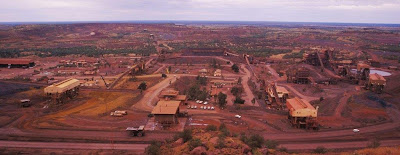
Newman Iron Mine Mill

Issues in the election: banning uranium mining, not allowing genetically modified crops, managing the mining and energy boom economic windfalls, prohibiting new drivers to operate cars with V8 engines, corruption and lobbyest influence, managing development of the Perth metro area.

The election is Sept 6. More on the unique way votes are counted in the next blog.

Friday, August 15, 2008

Remembering Bernie Mac


This has little to do with Australia, but I was working on the Bernie Mac Show the year we were applying for Australian migration. In fact most of my DIMA forms were written in the camera office next to Bernie's dressing room.

Bernie died this week. He was only 50. He was a very nice, sweet, caring man. That might not seem like the edgy, politically incorrect image he projected, but that was truly what he was: funny, irreverant, but thoroughly decent. He told the truth the about life the way he saw it. He never forgot his roots but enjoyed his accomplishments and the position in life he'd achieved. A real loss, he had a lot more to give the world. Last time I saw him was when I visited the set our first trip back to the US in '04. He remembered me, invited me into his dressing room. He put on his oxygen tubes and wanted to know how I'd been. He was truly larger than life. He loved to walk around the set singing in his falsetto: "You can stick it in the crack of yo' ass..." I can still hear him. I'll miss him. If there is a heaven I'll look forward to seeing him again...and having a good laugh.

Thursday, July 3, 2008

4th of July on June 29th


Had a table selling my book at the American Womens' Club of Perth 4th of July picnic on 6-29, held then because the 4th isn't a holiday in Australia. Australians celebrate Australia Day on January 26, during the southern summer, usually with a picnic and a sky show (fireworks), and consumption of copious amounts of brew and alchopops (fruit and hard liquor in a can which goes down much too easy, but that's for another post).


Met lots of ex-pats at the picnic, young and old, long timers and new comers, including Ken Churn, the US Consul to W. Australia. Many are married to Aussies, others are in WA for work: BHP, Chevron, etc. Others are like me, rat-race dropouts. Nice to see so many Yanks.

Thursday, June 26, 2008

Jumping Off to Vanuatu


One of the great things about living in Australia is that it's a great jumping-off point for exploring SE Asia and the S. Pacific. Last week I shot a doco (Aussie for documentary) for Oz Downunder in Vanuatu (the former New Hebrides), including a segment on how the islanders are eradicating the Crown of Thorns starfish that threatens the reefs. Tucked in the warm, clear S. Pacific between New Caledonia and Fiji, it's where Michener wrote Tales of the South Pacific. A diver's paradise: incredible corals, fish life, wrecks (including the largest divable wreck in the world: the SS President Coolidge which hit a mine and sank just off the beach off Luganville) in 80 degree water and up to 100' viz. Vanuatuans are the friendliest folks on the planet. And it's all only a short flight from Brisbane. Special thanks to Peter of Sailaway Cruises in Poet Vila, Charmane of Coral Quays hotel on Santo, Allan, Tony and Alfred of Allan Power Diving in Luganville, and the people of the village of Laonamoa on the island of Pele. And a special compliment to the US Peace Corps volunteers I met over there, doing a terriffic job and having a good time doing it.

Thursday, May 22, 2008

Business: Identification

To open a bank account, to apply for a driver’s license, or to enter into other bureaucratic situations, you’ll need ID. Identification has been formalized into a 100 Points System, i.e. you’ll be required to produce 100 points of identification. Your passport is worth 70 points, a driver’s license is 40 points, a credit card or a Medicare card is 25 points, and a video store rental card (I’m not making this up) is 25 points. Utility bills are 20 points. One reason for this is so only legal residents can open bank accounts.

If you’re migrating and don’t already have your own Australian bank account, you can wire money to a friend or relative in Australia. If it’s a large amount, they can open an account in their name and list it In Trust to your name. However, beware: they may have to show it on their taxes. Don’t do this if the money will be in their account at the end of the tax year, June 30th.

Wednesday, May 21, 2008

Dressing for Business

Australians are casual dressers, but they dress up for business.

Business suits are common in the CBD (Central Business District) for lawyers, accountants, and businessmen. This is usually a two-piece or vested suit, black or with an understated stripe, four-button or double breasted. Once in the office, the coat generally comes off, but the tie stays on.

Engineers and less-formal white collar workers will wear slacks and a pressed, button-front shirt. Ties are rare.

Many workers who come into contact with the public wear uniform shirts. Real estate reps, bank workers, etc., wear ironed, button-front shirts or blouses with the company logo embroidered on the breast—name tags are common. Salespeople, counter clerks, car dealers, etc., wear golf or polo shirts with printed or embroidered logos on the breast. The color is usually the same for everyone in a particular shop, so finding a salesperson is easier. One reason for the widespread use of uniform shirts is because Aussies are very casual dressers, and with required uniforms they are forced to dress presentably.

Tradesmen will commonly wear hi-vis (florescent) yellow, lime, or orange-colored shirts, for high visibility and safety. This is especially true for truckies, heavy machinery operators, road crews, or construction workers. These will commonly have logos on the breast and are UV-resistant (the southern sun is merciless). Shorts are common for working men. Blokes (men) under forty wear long ones that go below the knee. Older blokes wear them short, just below the bum (butt).

Monday, May 19, 2008

Business: Banking in Australia

The major banks are ANZ (pronounced A-N-Zed), Westpac, National, and Commonwealth. They’re known as the Big Four. There are also smaller banks and credit unions. Most banks seem to follow a Monty Python approach to business and bureaucracy, so come armed with patience. If you don’t like the first answer you get, ask someone else (in Australia, an organization is truly a group of individuals). Just when you think everybody there is hopeless, someone will come through for you.

The equivalent of a U.S. Certificate of Deposit (CD) is called a Term Deposit (TD). Checks are spelled cheques. Fees are charged on most transactions.

In Australia, there’s no insurance on savings equivalent to the U.S. FSLIC or FDIC, but under the Banking Act of 1959, depositors in an Authorised Deposit-taking Institution (ADI) have to maintain assets to back their deposits (be it land, gold, cattle, etc.) and in the event that the bank goes belly up, the depositors are to be repaid first—before the bank’s creditors. What does this mean to you? If the bank fails, you won’t be paid out directly, but will have to wait in line and hope there’s enough to go around. Bottom line: all money deposited is on faith in that institution, so it seems prudent to go with one of the big ones and learn to put up with the frustration. Besides, they usually have more ATMs.

Sunday, May 18, 2008

Business: the shares (stock) market

Stocks are called shares, the stock market is the share market (also called the Bourse). Shares are traded through brokers and online brokerages (such as banks, etc.), just as in the U.S.
The Australian Shares Exchange is the ASX. All publicly traded companies are registered with ASICS (the Australian Securities and Investments Commission) equivalent to the U.S. Securities and Exchange Commission. All securities traded online with the ASX are cleared and settled through CHESS (Clearing House Electronic Sub-register System), which is owned by ASTC, the Australian Stock Exchange Settlement and Transfer Corporation, which is owned by the ASX. Details are on www.investasutralia.gov.au.

Saturday, May 17, 2008

Australian Business: Land Ownership

Methods of land ownership Freehold, leasehold and Crown land are the basis of land ownership in Australia.

Freehold means privately-owned land. This can be bought and sold.

Crown land is government-owned land and can be used for parks, utilities, airports, government facilities, granted to individuals or corporations, sold as freehold land, or leased. The Crown originally referred to the Royal Family, but it now applies to any government land ownership, be it state or federal. The land is held in the right of the Crown, and the Crown has legal rights as an individual land owner. About half of all Australian land is Crown land, including ninety-three percent of Western Australia.

Leasehold is where an individual or corporation buys a long-term lease on Crown land, usually ninety-nine years, and can treat the lands as if they owned it privately. Throughout the interior, huge tracts consisting of hundreds of square miles of Crown land are leased as cattle and sheep stations. The backbone of the economy—the mining industry—is entirely on leased land.

Thursday, May 15, 2008

Small country on a big lot.

You've gotta love living in a country of only 21 million people. Since moving here in 2003, I've become involved in the community doing some land-preservation activism, and helping with my kids' high school Parents & Citizens group (equiv. of PTA) . Through these activities I've had the opportunity to meet with several members of the State Parliament, including both of the last two oppostition leaders and the previous Premier (equiv. of a state governor). I've also met with several members of the Federal Parliament, and last week had the opportunity to meet the Deputy Prime Minister, Julia Guillard (equiv. of the U.S. Vice President--just try to get close to Dick Cheney). Not bad for only being in the country five years.